Showing posts with label the classic cocktail. Show all posts

Friday, June 14, 2013

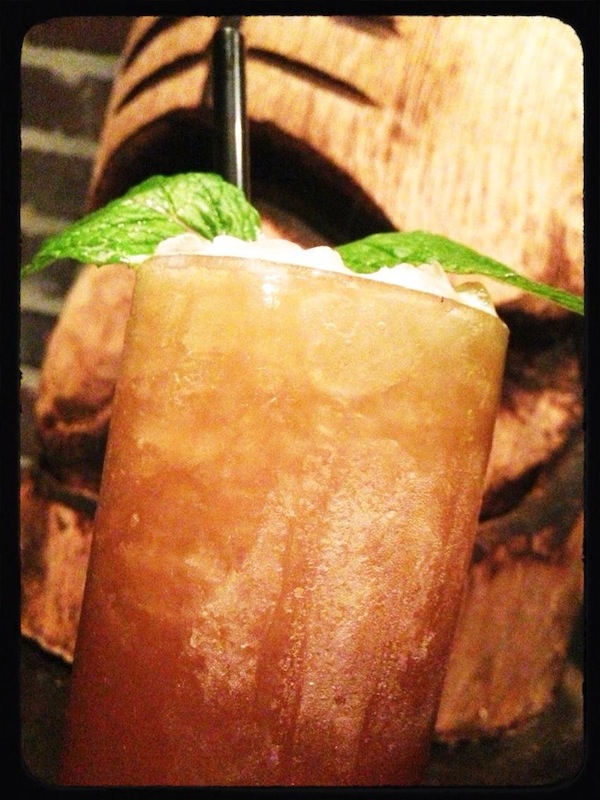
Panorama Punch


Seattle probably isn’t the first place you think of when someone starts talking about tropical drinks.

During the middle of the twentieth century, the Polynesian Pop movement that was usually just referred to as “Tiki” was in full-bloom across the USA. Seattle was not spared from the light of Tiki torches, rattan furniture, or rum-based libations with fun names. And when the 1962 World’s Fair came to Seattle, locals and tourists were treated to some fantastic drinks high in the famous Space Needle. One of those drinks was named the Panorama Punch.

Of course, in true Tiki style, there are different reports on how the drink was made. According to an old Trader Vic’s guide, the drink was made with rum, Cointreau, gin, and grenadine. Jeff “Beachbum” Berry reports that the recipe was actually concocted with rum, simple syrup, cranberry, orange, and lime juices, and blended with crushed ice for two people. The secretive nature of Tiki cocktail culture means that the absolute truth is probably out of reach (but also probably favors the Bum).


Panorama Punch 
1 oz Appleton Estate Reserve Jamaican Rum
1 oz Clement VSOP Rhum Agricole 
2 oz Orange Juice
1 oz Cranberry Juice 
1/2 oz Lime Juice 
2/3 oz Orgeat


Shake with crushed ice and pour into a goblet. Garnish with mint. 

When we introduced Tiki Tuesdays at 320 Main, one of the drinks we were most excited to bring to the bar was our take on the Panorama Punch. It proved to be so popular that Jason and Dave put it on the regular menu so that you can sip the delectable drink any day of the week.

As noted in Beachbum’s BeachbumBerry Remixed, the Western Guest Magazine said the Panorama Punch, “...is especially good for toasting the 21st Century or just about anything.”

----
Matt “RumDood” Robold is a bartender at 320 Main and, in his spare time runs RumDood.com, where he writes about rum, rum cocktails, and rum history.


Monday, April 29, 2013

The Old Cuban


It’s like a Mojito, only turned up to eleven!

This was the reaction I got from the first person I ever handed an Old Cuban. It’s not entirely incorrect.

At the famous Pegu Club in New York, Audrey Saunders forged a reputation for brilliance and cocktail program excellence that is hard to even contemplate matching. There is a reputation of exactness and consistency that is well earned - and this comes through in the excellence of this cocktail.

The recipe calls for aged rum, lime juice, mint, bitters, and champagne, and it is as brilliant as it appears inevitable. If the Mojito is a drink for beach parties, the Old Cuban is one for elegant soirees on your yacht.

Old Cuban
1 1/2 oz Aged Rum (Santa Teresa Claro)
3/4 oz Lime Juice
1 oz Simple Syrup
2 dashes Angostura Bitters
6 Mint Leaves
Champagne

Add all but champagne to a shaker. Muddle mint. Shake with ice. Strain into chilled coupe glass and top with champagne.

In New York, Audrey and her crew make the Old Cuban with Bacardi 8. At 320 Main, we’ve gone with Santa Teresa Claro - a lightly aged rum from Venezuela that many people say is the closest rum you’ll find in the US to Havana Club from Cuba. Pegu Club also garnishes with a sugar-coated vanilla bean whereas we opted for a simple mint leaf.

Refined and refreshing at the same time, the Old Cuban takes the Mojito’s combination of tart, sweet, and effervescence and adds character through the age of the rum, the complexity of the bitters, and the style of champagne.

----
Matt “RumDood” Robold is a bartender at 320 Main and, in his spare time runs RumDood.com, where he writes about rum, rum cocktails, and rum history.


Tuesday, April 2, 2013

Zombie

These are probably not the first words that come to mind when someone uses the word “zombie” these days. Most people probably begin to talk about their favorite scenes from John Romero or that TV show on AMC.

Find a good bartender though, and ask them about a Zombie. That twinkle you see in their eyes (or is that dread?) is a brain cycling through a list of ingredients a mile long, and a cocktail history that can match it.

Ernest Raymond Beaumont Gantt was born in Texas in 1907. It seems like an unlikely name and birthplace for the person largely held as being responsible for the Polynesian pop-culture phenomenon known as “Tiki” - but that’s probably why he eventually changed his name to Donn Beach better known as Don The Beachcomber.

Gantt travelled the world as something of a vagabond - visiting places in the South Pacific and the Caribbean specifically - before finding himself in Los Angeles in the early 1930’s. It was there that he took over a small shop and turned it into a bar: Don’s Beachcomber Cafe.

The future Don had very little money, but he had picked up a thing or two about rum punches while in Jamaica, and rum happened to be dirt cheap at the time. So combining his incredible charm, cheap but exotic rum, and the base of Jamaican Planter’s punch, he began building an empire drink by drink. Of his most famous creations, the Zombie may rule the roost.

In 1934 Don unleashed a mixture of four full ounces of rum including a full ounce of overproof rum - on the world. The drink was potent already - but, using his knack for flair, Don made it even more mysterious and alluring by declaring right on the menu that no customer was allowed to have more than two zombies because it was just so strong.

Zombie (1934)
1 ½ oz Jamaican Rum
1 ½ oz Gold Puerto Rican Rum
1 oz 151 Demerara Rum
¾ oz Lime Juice
½ oz Falernum
½ oz Don’s Mix*
1 tsp Grenadine
 
1 dash Angostura Bitters
1 dash Absinthe

Blend with ¾ cup of crushed ice for 5 seconds. Pour into a chimney glass and top with crushed ice. Garnish with fresh mint. 


There’s even a story - almost certainly too amazing to be true - that Don once had a run in with the mob over the Zombie. As the story goes, two mobsters wandered into Don’s one night and had two zombies a piece. When one of them tried to order a third, Don refused, and things got a bit heated. To cool things off, Don suggested that the mobsters come back the next night and if they could drink three zombies, he’d give them his bar.

The mobsters returned the next night, Don made them each their first zombie, then their second, and then their third. Before getting even halfway through their third round of drinks, both men collapsed on the bar - leaving Don victorious.

Per the legend, Don had won rather nefariously. Rather than making the drink according to his regular recipe, Don had added glycerine to the mixture - a move that was guaranteed to ensure that the drinks acted much faster on the mobsters than they normally would have.

Over time, many of Don’s recipes - even recipes for INGREDIENTS in his drinks - were lost. It took dedicated historians and drinkers to bring them back. Most of all, we have Jeff “Beachbum” Berry to thank for bringing the modern world not just the Zombie (for which he found numerous recipes), but the original, 1934 Zombie punch recipe (you should really get a copy of Jeff’s book, Sippin’ Safari to get not only the recipes, but the stories behind finding them).

Thanks to Jeff’s hard work, at 320 Main, we can serve you Zombies that we feel honor Don’s hard work and absolute boozy genius. Of course, we lack the blender that the recipe calls for, so we make do by shaking with crushed ice until our arms scream for mercy and our hands freeze to the tins - sacrifices well worth the smiles of the Tiki gods.

*Don’s Mix is a mixture of grapefruit juice and cinnamon syrup. You can make your own, or you can do what we do and order it from B.G. Reynolds’ Syrups and have it at the ready for all of your Tiki needs!


----
Matt “RumDood” Robold is a bartender at 320 Main and, in his spare time runs RumDood.com, where he writes about rum, rum cocktails, and rum history.


Monday, November 26, 2012

Bridget 75


In 1898 the French army adopted a new field gun (we’d probably just call it a canon) that is widely considered to be the first modern artillery piece. The Materiel de 75mm Mle 1897, which saw extensive use in World War I by the Allied Forces, was commonly referred to as the “French 75” by English speakers. On October 23, 1917, the first artillery shells fired by the US Army in World War I were fired by a French 75 that the soldiers had named “Bridget.”

What does this have to do with drinking?

In 1915 a Scottish barman named Harry MacElhone was running The New York Bar (later called Harry’s New York Bar) in Paris. It was there that MacElhone named a new cocktail consisting of gin, lemon juice, sugar, and champagne on his menu the French 75.

Bridget 75
¾ oz Bonded Applejack
¾ oz Gin
¾ oz Lemon Juice
¾ oz Simple Syrup
1 oz Champagne


Combine all but champagne in a cocktail shaker and shake with ice. Strain into a chilled coupe and top with champagne.

As Fall has eventually found its way to Sunny Southern California, 320 Main decided to take the drink that took Paris and, eventually, New York and other points West by storm, and give it a bit of an American twist and Fall flavor. A little bit of apple goes a long way to making this refreshing drink feel at home among cooler temperatures and red and orange leaves.

Notes:
● It is often debated whether the French 75 originally called for gin or - as many people know it - with Cognac. While there are some notable references to the drink being made with cognac, the earliest references all seem to point to gin as the original base-spirit.
● Noted cocktail historian (yes, that’s an actual job that your guidance counselor hid from you) David Wondrich has pointed out that the combination of gin, citrus, sugar, and champagne can actually be traced back as far as 1867, when Charles Dickens encountered it during his travels to America (though Dickens specifically mentions Old Tom gin, which would have had a different flavor).


----
Matt “RumDood” Robold is a bartender at 320 Main and, in his spare time, runs RumDood.com, where he writes about rum, rum cocktails, and rum history.

Tuesday, November 6, 2012

Cocktails 101: Drink Size

Is bigger always better?

At 320 Main, we get asked a lot about the sizes of our cocktails. It’s true, our drinks aren’t the biggest you’ll find. There are no 10 ounce martinis or yards of margaritas to be found anywhere near the bar.

Why is that? Well, we decided to put together a video to try and explain.


Basically, our drinks are the size that they are because we think they taste the best at that size. Cocktails are usually made with ice – either shaken or stirred. That ice melts and can change the characteristics of the drink as you drink it.

Our goal is consistency. We want every cocktail to be great, but that’s not enough. It has to be great for every single sip, so that your last sip is still as good as your first.

Accomplishing this goal requires us to carefully control how much of that ice for you cocktail ends up as water diluting your drink. Since we take such great care to keep that drink balanced, we don’t need glasses large enough for swimming in – just large enough for tasting delicious.

----
Matt “RumDood” Robold is a bartender at 320 M
ain and, in his spare time, runs RumDood.com, where he writes about rum, rum cocktails, and rum history.

Friday, October 12, 2012

Tiki Tuesdays

BBQ pork belly and pineapple sandwich

Being a classic cocktail bar is serious business. Why else would it seem like any bar or restaurant that’s adhering to the tenants of classical mixology is decorated in browns and blacks with bartenders featuring collared shirts and various styles of facial hair?

Of course the entire point of having a cocktail is to have a good time – to escape from the rigors of the day and find just a little piece of zen. It’s about letting your hair down, taking off your jacket or loosening your tie, unbuttoning your collar, and enjoying life.

Even stuffy classical bartenders like to let down their hair from time to time. That’s why 320 Main has made it a habit to host occasional Tiki Nights, complete with guest bartenders, DJ’s, and special hot dogs a few times per year.


Unfortunately, “a few times a year” doesn’t seem to slake the thirst of our patrons when it comes to tropical tinctures with rum and coconut cream. The most common refrain we hear after finishing a Tiki event is, “When are you having another one? You guys need to do this more.” 

Three Dots & A Dash
Message received.

Now you can tropically tipple every Tuesday night, as 320 Main has introduced Tiki Tuesdays.

Every Tuesday night we roll up the red carpet and replace it with a bamboo mat and a special menu with $8 drink specials including the Three Dots & A Dash, Planter’s Punch, and Navy Grog. If you’re looking for something a little more adventurous, you can hack your way through the jungle to find Painkillers, Martin Cate’s famed Pampanito, or even a Zombie if you’re feeling particularly brave.

And because nobody likes tropical getaways without great food, you can pair your cocktails with some delectable dishes from our kitchen. Enjoy BBQ Pork Belly and Pineapple Sandwich or other tropically-inspired specials from our head chef, James Wilschke

So now every Tuesday be sure to join us pau hana1
as we say ‘Okole maluna!2

1 “After Work”

2 “Cheers!”

----
Matt “RumDood” Robold is a bartender at 320 Main and, in his spare time, runs RumDood.com, where he writes about rum, rum cocktails, and rum history.


Tuesday, March 20, 2012

The Aviation

(The Aviation. Ingredients pictured right.)

The Aviation made its official debut in print around 1916 in a little book called Recipes for Mixed Drinks by Hugo Ensslin. The original recipe contained an ingredient called creme de violette. This liqueur gave the drink its pale gray and slight lavender hue. Due to its  discontinuation around the 1930's barkeeps began to alter the recipe. Harry Craddock, the legendary American bartender who left Prohibition in the States to tend bar at the Savoy in London where he created and popularized some of the most famous cocktails to date, printed a revised version of the Aviation in his Savoy Cocktail Book. Craddock's version called for 2/3 dry gin, 1/3 lemon juice and two dashes of maraschino, ditching the now defunct creme de violette; a recipe most bartenders would follow from then on. That is until the recent cocktail resurgence in the 1990's when creme de violette made its grand (although limited) return to the market.

The original Aviation recipe as seen in
"Recipes For Mixed Drinks.
One thing 320 Main is all about is serving up the best cockatails out there, which means Jason Schiffer and the gang are constantly changing and honing in their recipes, either via their own trial and error, or by taking cues from fellow members of the craft. Recently some friends introduced Jason to a version of the Aviation cooked up by fellow spirits blogger Jason Wilson of Boozehound. It was love at first sip. Wilson, refines the original recipe down to a tighter formula with more proportional ingredient measurements making it brighter and more well balanced. It was immediately apparent that 320 Main had to adopt Wilson's version.


The Aviation
As Perfected By Jason Wilson

1 1/2 oz Beefeater Gin
3/4 oz Lemon Juice
1/2 oz Luxardo Maraschino
1/4 oz Creme de Violette

"What's great about this cocktail is it is a perfect aperitif. The fresh lemon juice stimulates the appetite with its citric acid while the Maraschino Liqueur dries the back palette." 
- Jason Schiffer

Wednesday, December 7, 2011

Cocktail Spotlight: The Oude Fashioned


Today's Cocktail Spotlight is on The Oude Fashioned, Jason Schiffer's variation on the original cocktail. This cocktail features Bols Genever Barrel Aged, a Dutch spirit. "Oude" is Dutch for old, thus the name, The Oude Fashioned.

What is Bols Genever? It's what gin evolved from but it's not a gin, it's in a category all it's own. Lucas Bols has been distilling Genever in Holland since 1664. Bols Genever is distilled from "maltwine", a combination of corn, wheat and rye grains. At blend of at least 15% maltwine distillate is combined with a distillate of juniper berries and other botanicals. Genever means "juniper" in Dutch. Back in those days, alcohol was medicinal and juniper berries were believed to help with kidney sickness. In the 17th century, its purpose expanded to include "liquid courage". Dutch soldiers would drink shots of Genever before they forged into battle, coining the phrase "Dutch Courage."
Eventually, the Brits would draw from the Genever recipe to create a variation that came to be known as London dry gin. Bols Genever was very popular during the early 1700s but disappeared later in the 1800s when many of the drinks that once used Genever began using gin instead. With the recent resurgence of mixology and craft cocktails came a renewed demand for Genever. Bols came out with a Genever that was released in the U.S., only to also find demand for the original Barrel Aged recipe. They released a limited edition Genever, barrel aged in French Limousin oak and bottled in clay. Due to it's extremely limited quantity, only a select few bars dedicated to craft cocktails were given the spirit. One of those exclusive bars was yours truly, 320 Main. 

Stop into 320 Main and grab an Oude Fashioned before supplies run out. It may just give you the "Dutch Courage" you need to tackle your dreaded holiday shopping. 

Tuesday, November 29, 2011

November Centerfold: Moscow Mule featuring 320 Main Copper Mugs


History Behind The Moscow Mule: Created in 1941 by Jack Morgan of the Cock N' Bull Tavern in Los Angeles and John G. Martin of the Hublein Company. John was introducing a Russian vodka to the United States and Jack had an overstock of ginger beer.  The two created the cocktail and teamed up with a friend of Jack's who had recently purchased a copper factory. Photos of the celebrities who frequented the Cock N' Bull Tavern on Sunset Boulevard enjoying the drink helped fuel sales as everyone wanted "the drink in the copper mug!"

See Jeffrey Morgenthaler's ginger beer recipe here.

Tuesday, November 15, 2011

Laird's Apple Brandy: A Truly American Spirit

Laird’s Bonded Apple Brandy and AppleJack are quite possibly my favorite spirits.


AppleJack was the first commercially distilled spirit in America and the Laird family established America’s first commercial distillery in Scobeyville, New Jersey in 1780. Scotsman Alexander Laird emigrated in 1698 and began producing AppleJack for his family’s use. Fast forward to 1760 when descendant Robert Laird served in the Revolutionary War under George Washington and the Laird family supplied the troops with Applejack. Mr. Washington himself was a fan, requesting the recipe and referring to the "cyder spirits" in his diary. 

The name AppleJack supposedly refers to the term Jacking, meaning creating a spirit from freeze distillation. This method involves freezing a fermented product (i.e. apple cider) and scraping the softer, high alcohol contents away from the frozen water. This method declined because the byproducts of fermentation (methanol, ethanol, etc.) cannot be separated and it was therefore inferior to evaporative distillation. Today’s AppleJack is made from naturally fermented apples which are distilled and aged for 4 to 8 years. This Apple Brandy is then blended with 65% neutral spirits to create AppleJack. Lairds also produces Bonded Apple Brandy, a 100 proof spirit made from 100% apple brandy aged 6 to 10 years.


The unique flavor of AppleJack is reason enough to stock your bar with it and it is also essential for classics such as the Jack Rose. But aside from these two reasons, I personally feel a sense of pride in being able to go through our country's history and collect things that are uniquely American such as this classic spirit. We are a young country and there are so few things that you can trace back to the beginning of America. It’s kind of my way of discovering who I am as an American - a way of reminding myself what it is to be American. We are entrepreneurs, inventors, builders and makers of things. It’s what we do. It’s who we are. That is why I love AppleJack. It is American through and through. Before there was Bourbon there was Rye and before there was Rye there was AppleJack, Laird’s AppleJack. 
- Jason Schiffer
Owner
 The Jack Rose is one of six basic drinks listed in David A. Embury's classic bar book "The Fine Art of Mixing Drinks."  The drink was popular in the 20's and 30's.

Jack Rose
1.5oz. Applejack
.5oz. Lemon or Lime Juice
.5oz. Grenadine
Shake/strain into a chilled cocktail glass
and garnish with a brandied cherry. 


What our friends say about the Jack Rose:
http://www.cocktailmusings.com/2010/02/jack-rose.html
http://sloshed.hyperkinetic.org/2008/07/02/jack-rose-cocktail/
http://davestolte.com/?p=369 and http://www.homebarbasics.com/?p=390

Monday, October 3, 2011

The Bowery: 320 Main's Take on The Manhattan

Fall is finally arriving, slowly but surely. These hot 80 degree days are giving way to shorter, cooler ones. To usher in the autumn season, 320 Main is introducing it's newest addition to the cocktail menu, The Bowery. Named after the colorful neighborhood in Lower Eastside Manhattan, this cocktail is a variation of the the classic Manhattan.

"The Bowery is actually what cocktail people would call a Black Manhattan, a riff on the classic Manhattan cocktail using an Amaro as the Sweet Vermouth. John Coltharp of The Tasting Kitchen in Venice gave me my first taste of Ciociaro Amaro, I told him it reminded me of the original formula Amer Picon, (a pre 1970 Amaro I was lucky enough to taste) but a little sweeter and without the dried orange notes. This Amaro is so special, the cocktail needed it's own name." -Jason Schiffer


In Italian, amaro means "bitter" these bitters or amari are usually made by macerating various herbs, roots, spices, bark, flowers and/or citrus in a neutral grain spirit or wine. Sugar is then added before being barrel or bottle aged. The classic recipe for a Manhattan  includes equal parts rye whiskey and sweet vermouth with a dash or two of bitters. The 320 Main crew makes this Manhattan-style cocktail with Bulleit Rye Whiskey, Bitters and the Amaro Ciociaro. Bulleit Rye Whiskey is a fairly new label that is full of character - much like it's creators.

The Bowery: Bulleit Rye WhiskeyAmaro
Ciociaro and bitters. Click to Enlarge.
As the legend goes, in the 1820s a young Augustus Bulleit emigrated from Alsace-Lorraine, France.  Around 1840, Augustus Bulleit moved from New Orleans to just outside Louisville, KY and established himself as a tavern keeper, where he began producing small batches of bourbon. Hell bent on perfection, he experimented with countless recipes, finally finding one that met his expectations. Bulleit Bourbon was born. Bulleit bourbon sold throughout Kentucky, Indiana, and New Orleans where it quickly gained the reputation as the bourbon of choice for America's frontiersmen.

In 1860, while transporting barrels of whiskey from Kentucky to New Orleans, Augustus Bulleit mysteriously disappeared just outside of New Orleans. Walter Q. Gresham, Secretary of State under President Grover Cleveland formed a search party to travel from Indiana to New Orleans. The searchers came back empty handed, his body was never found. After Augustus’s disappearance, it seemed the making of his bourbon would disappear with him. However, in 1987, more than a century later, Tom Bulleit fulfilled a lifelong dream by starting a distilling enterprise inspired by the original recipe of his great-great-grandfather. [Bar None Drinks]

What do you get when you mix all these fine spirits and bitters together? The Bowery, a delicious take on the original with accentuated depth and richness that is perfect for fall.
Pairs well with: The Filet Mignon

Monday, August 22, 2011

The Illustrious History of The Cocktail


The cocktail is America’s gift to the culinary world. The cocktail has endured a long journey from its pure beginnings, through the hardship and compromise of the '20s and '30s speakeasies, to where it stands now. The cocktails of today are a far cry from their original predecessors. But thanks to a resurgence of interest in the great American cocktail of yesteryear and the craft movement, cocktails are making a comeback to their former glory. To get an idea of just how far the cocktail has come, let’s go back to the very beginning.

In 1806, a newspaper called The Balance, and Columbian Repository printed the first definition of the cocktail: “A stimulating liquor, composed of spirits of any kind, sugar, water, and bitters.” The most common spirits used in cocktails at that time were rum, brandy or Genever. The use of water was to help dissolve the granulated sugar (or sugar cubes) into the mixture. At that time, ice was not a key ingredient of the cocktail yet, but when it later became more prevalent, ice would be used to dilute the drink through stirring, thus blending the individual components more harmoniously. Around the latter half of the 1800s, people would call for their spirit of choice (now predominately whiskey) to be made “the old fashioned way.” The name stuck.

In the 1920’s, when Prohibition hit, things got a little rough for the cocktail and all those dedicated to maintaining its original purity. The professional bartender left overseas to practice his trade where drinking was still legal. Prohibition made the creation, distribution and consumption of alcohol illegal, so people took to making their own liquor. Needless to say it was less than impressive. It was because of this unsavory homemade booze that people began mixing cocktails in such a way as to drown out the bad taste of these less than palatable spirits. Prohibition killed the cocktail in America.

From that point on, the drinking culture in America shifted from appreciating a hand crafted drink made properly with fresh ingredients, to a culture just looking to get drunk as fast as possible on bad booze masked with sweet additives (juice, sugar, high-fructose corn syrup, etc).

Like the old saying “you can’t keep a good dog down”, quality things always manage to come back around. In the same way that the microbrewery and the craft beer reminded us that beer was meant to be enjoyed for its taste, people are beginning to rethink the way they view the cocktail. When you have a steak, you want it to taste like steak, prepared with ingredients that complement the flavor of the meat, as opposed to flavors that mask it. Cocktails are the same way. Made correctly - with fresh ingredients, quality spirits, and at the hands of a knowledgeable bartender - the flavors of a cocktail complement each other to make something truly exquisite. 320 Main is dedicated to mixing cocktails according to the methods and philosophy which were established by the early American bartender.