Monday, April 29, 2013

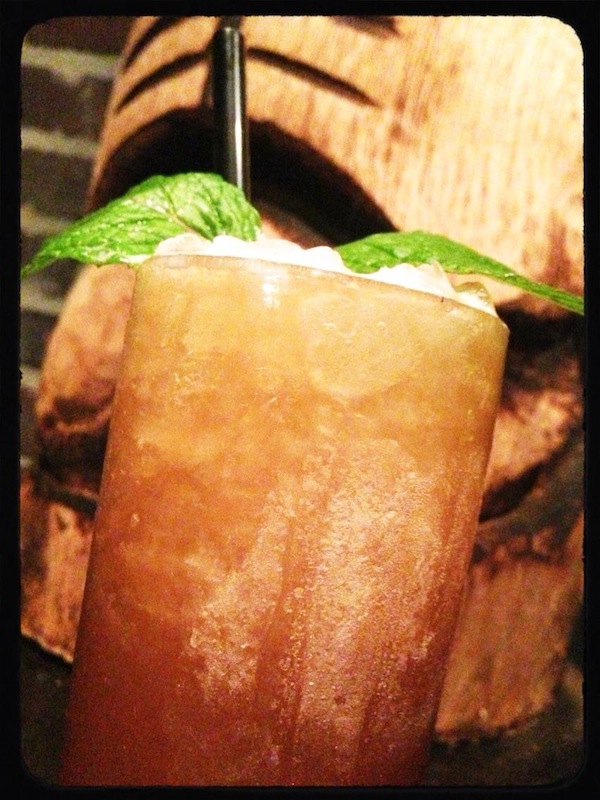
The Old Cuban


“It’s like a Mojito, only turned up to eleven!”

This was the reaction I got from the first person I ever handed an Old Cuban. It’s not entirely incorrect.

At the famous Pegu Club in New York, Audrey Saunders forged a reputation for brilliance and cocktail program excellence that is hard to even contemplate matching. There is a reputation of exactness and consistency that is well earned - and this comes through in the excellence of this cocktail.

The recipe calls for aged rum, lime juice, mint, bitters, and champagne, and it is as brilliant as it appears inevitable. If the Mojito is a drink for beach parties, the Old Cuban is one for elegant soirees on your yacht.

Old Cuban
1 1/2 oz Aged Rum (Santa Teresa Claro)
3/4 oz Lime Juice
1 oz Simple Syrup
2 dashes Angostura Bitters
6 Mint Leaves
Champagne

Add all but champagne to a shaker. Muddle mint. Shake with ice. Strain into chilled coupe glass and top with champagne.

In New York, Audrey and her crew make the Old Cuban with Bacardi 8. At 320 Main, we’ve gone with Santa Teresa Claro - a lightly aged rum from Venezuela that many people say is the closest rum you’ll find in the US to Havana Club from Cuba. Pegu Club also garnishes with a sugar-coated vanilla bean whereas we opted for a simple mint leaf.

Refined and refreshing at the same time, the Old Cuban takes the Mojito’s combination of tart, sweet, and effervescence and adds character through the age of the rum, the complexity of the bitters, and the style of champagne.

----
Matt “RumDood” Robold is a bartender at 320 Main and, in his spare time runs RumDood.com, where he writes about rum, rum cocktails, and rum history.


Tuesday, April 9, 2013

Duroc Stuffed Pork Chop


DUROC STUFFED PORK CHOP
Brie, Granny Smith Apple, Caramel Apple Sauce, Sweet Potato Puree
A pork chop is pork – meat from that magical animal that also gives us bacon, ham, and baby back ribs – that’s been chopped at a 90-degree angle from the spine of the swine. Depending on the chop, you’ll find a vertebrae or rib bone to provide a nice hand-hold for eating your delicious dinner.

But you probably know all of that. The odds are pretty strong that you’ve had a pork chop some time. Come to 320 Main, and you’ll be eating Duroc pork chops.

Durocs are a breed of red hog that was developed in New England around 1820. Legend says that the hogs are named for their breeder’s favorite horse, whose name was Duroc. The breed quickly caught on as a show pig as well as a source of good, lean pork. Famers, like the Compart Family Farms where we source our pork chops, gravitated to the hearty swine with a reputation for excellent marbling and low drip-loss.

Thinking of pork chops will inevitably lead to thinking of apples or applesauce. In fact, pairing pork with apples is about as natural as food pairings come. You can go as far back as the 1st Century in Rome and find recipes like minutal atianum, a ragout made with pork and containing apples.

The 320 Main pork chop is stuffed with Brie and Granny Smith Apple, topped with a caramel apple sauce, and served over a sweet potato puree. The massive chop is loaded with flavors: rich, crisp, savory, and sweet – and pairs beautifully with a classic like an Old Fashioned or a signature cocktail like the Crippled Creek.

Tuesday, April 2, 2013

Zombie

These are probably not the first words that come to mind when someone uses the word “zombie” these days. Most people probably begin to talk about their favorite scenes from John Romero or that TV show on AMC.

Find a good bartender though, and ask them about a Zombie. That twinkle you see in their eyes (or is that dread?) is a brain cycling through a list of ingredients a mile long, and a cocktail history that can match it.

Ernest Raymond Beaumont Gantt was born in Texas in 1907. It seems like an unlikely name and birthplace for the person largely held as being responsible for the Polynesian pop-culture phenomenon known as “Tiki” - but that’s probably why he eventually changed his name to Donn Beach better known as Don The Beachcomber.

Gantt travelled the world as something of a vagabond - visiting places in the South Pacific and the Caribbean specifically - before finding himself in Los Angeles in the early 1930’s. It was there that he took over a small shop and turned it into a bar: Don’s Beachcomber Cafe.

The future Don had very little money, but he had picked up a thing or two about rum punches while in Jamaica, and rum happened to be dirt cheap at the time. So combining his incredible charm, cheap but exotic rum, and the base of Jamaican Planter’s punch, he began building an empire drink by drink. Of his most famous creations, the Zombie may rule the roost.

In 1934 Don unleashed a mixture of four full ounces of rum including a full ounce of overproof rum - on the world. The drink was potent already - but, using his knack for flair, Don made it even more mysterious and alluring by declaring right on the menu that no customer was allowed to have more than two zombies because it was just so strong.

Zombie (1934)
1 ½ oz Jamaican Rum
1 ½ oz Gold Puerto Rican Rum
1 oz 151 Demerara Rum
¾ oz Lime Juice
½ oz Falernum
½ oz Don’s Mix*
1 tsp Grenadine
 
1 dash Angostura Bitters
1 dash Absinthe

Blend with ¾ cup of crushed ice for 5 seconds. Pour into a chimney glass and top with crushed ice. Garnish with fresh mint. 


There’s even a story - almost certainly too amazing to be true - that Don once had a run in with the mob over the Zombie. As the story goes, two mobsters wandered into Don’s one night and had two zombies a piece. When one of them tried to order a third, Don refused, and things got a bit heated. To cool things off, Don suggested that the mobsters come back the next night and if they could drink three zombies, he’d give them his bar.

The mobsters returned the next night, Don made them each their first zombie, then their second, and then their third. Before getting even halfway through their third round of drinks, both men collapsed on the bar - leaving Don victorious.

Per the legend, Don had won rather nefariously. Rather than making the drink according to his regular recipe, Don had added glycerine to the mixture - a move that was guaranteed to ensure that the drinks acted much faster on the mobsters than they normally would have.

Over time, many of Don’s recipes - even recipes for INGREDIENTS in his drinks - were lost. It took dedicated historians and drinkers to bring them back. Most of all, we have Jeff “Beachbum” Berry to thank for bringing the modern world not just the Zombie (for which he found numerous recipes), but the original, 1934 Zombie punch recipe (you should really get a copy of Jeff’s book, Sippin’ Safari to get not only the recipes, but the stories behind finding them).

Thanks to Jeff’s hard work, at 320 Main, we can serve you Zombies that we feel honor Don’s hard work and absolute boozy genius. Of course, we lack the blender that the recipe calls for, so we make do by shaking with crushed ice until our arms scream for mercy and our hands freeze to the tins - sacrifices well worth the smiles of the Tiki gods.

*Don’s Mix is a mixture of grapefruit juice and cinnamon syrup. You can make your own, or you can do what we do and order it from B.G. Reynolds’ Syrups and have it at the ready for all of your Tiki needs!


----
Matt “RumDood” Robold is a bartender at 320 Main and, in his spare time runs RumDood.com, where he writes about rum, rum cocktails, and rum history.


Monday, February 11, 2013

The Sazerac

The Sazerac at 320 Main

Can a cocktail capture the essence of an entire city and its culture?

When people think of New Orleans, probably the first thing they think of is the Hurricane -­ a mixture of passion fruit and rum served out of a curvy glass that is probably festooned with beads that have been earned in ways that aren’t appropriate to discuss here. Certainly the Hurricane may capture the devil-may-­care attitude of a French Quarter bursting with tourists looking for a good time, but some would argue that a better capsule of the Big Easy would be the Sazerac.

The history of the Sazerac is clouded in the haze of history, buried amongst a host of tall tales and big personalities. It is the amalgamation of ingredients plucked from people like Antoine Peychaud - a Creole pharmacist whose aromatic bitters were sold for various stomach maladies and are still a staple of any serious cocktail bar today -­ and Sewell Taylor, who was the sole importer of a brand of cognac known as Sazerac-­de-­Forge et Fils (they weren’t great at naming things simply back then).

Prior to moving into the importation business, Taylor had sold his “coffee house” ­ a euphemism for “bar” that was popular at the time ­- which came to be owned by a man named Aaron Bird. It was most likely Bird who began to mix a concoction of Sazerac cognac, sugar, and a local bitters made by Peychaud, and sold it as the Sazerac Cocktail.

The Sazerac continued to evolve as New Orleans continued to grow as a mixture of French, Creole, and American culture. After a few decades of changing hands, The Sazerac House, as it had come to be known, came under the stewardship of Thomas Handy. By this time the cocktail had evolved to include a dash of absinthe, often as a rinse added to the glass in which the drink was served. Handy’s time roughly coincided with an epidemic that devastated the French wine industry, and thus rendered cognac nearly impossible to come by. Being a man who didn’t want to give up on the house cocktail, Handy is often credited with replacing the cognac with American-­made rye whiskey. When absinthe was banned in the United States, the still­-legal Herbsaint pastis ­ - produced right in New Orleans,­ was used in its place.

Perseverance through changing culture, laws, and refusing to be washed away by hurricanes? How could the Sazerac NOT be the embodiment of New Orleans?

At 320 Main, we try to honor the tradition of the drink and make a Sazerac that will have you ordering gumbo and wearing linen suits.

Sazerac
2 oz Bulleit Rye Whiskey
2 tsp Rich Simple Syrup
3 dashes Peychaud’s Bitters 

1 dash Angostura Bitters

Chill a double old fashioned glass and set aside. Mix ingredients in a mixing glass and stir with ice until cold. Rinse the old fashioned glass with absinthe, strain cocktail into glass. Garnish with a lemon twist.

At the end, your drink is spicy, sweet, and rich -­ everything you’d expect from New Orleans.

For more information and history on the Sazerac, check out Chuck Taggart’s article over at Gumbo Pages, or pick up a copy of David Wondrich’s masterful Imbibe!


----
Matt “RumDood” Robold is a bartender at 320 Main and, in his spare time runs RumDood.com, where he writes about rum, rum cocktails, and rum history.